
Alternatives guide
Best Canva AI Alternatives in 2026
Editorially researched alternatives to Canva AI for generative design, video, and marketing copy — covering Midjourney, Runway, ChatGPT, Jasper, Descript, Adobe Firefly, and Microsoft Designer.
Best Canva AI Alternatives in 2026
Context
Why people look for alternatives
Creators look beyond Canva AI when they need higher-end generative image control, motion-first video, transcript-native editing, or a marketing-grade copy system that templates alone cannot deliver.
Options
Alternatives

Specialist generative image quality and aesthetic exploration beyond template-first design.
Best for · Art directors and marketers who need distinctive campaign imagery.


Commercially safe generative image and video models inside the Adobe stack.
Best for · Studios already paying for Photoshop or Premiere who need AI on-brand assets.
Free prompt-to-design and image generation tied into Microsoft 365.
Best for · Teams on Copilot who want design drafts without a separate subscription.
Shortcuts
Quick picks
Best overall
Best lower cost
Best free
Best for teams
Best specialist
Questions
FAQ
01
Can Midjourney replace Canva?
01
Can Midjourney replace Canva?
For pure image generation, often yes. For layouts, brand kits, and non-designer editing, Canva still wins.
02
Is Runway a design tool?
02
Is Runway a design tool?
Runway is a generative video and creative-video platform, not a Canva-style template suite.
03
Do you publish hands-on scores?
03
Do you publish hands-on scores?
No. This alternatives page is editorially researched, not hands-on tested.
Deep dive
Full guide
What are the best Canva AI alternatives in 2026?
The best Canva AI alternatives in 2026 are Midjourney for premium generative imagery, Runway for AI video, ChatGPT for ideation and quick drafts, Jasper for marketing copy at scale, Descript for transcript-native video editing, Adobe Firefly for commercially safe generations inside the Adobe suite, and Microsoft Designer for free prompt-to-design tied to Microsoft 365. Each one beats Canva on a specific job — none of them beat it on the all-in-one everyday design job.
Canva AI still ships the fastest path from blank page to on-brand social post. That’s why Canva’s own about page claims 220M+ monthly active users and 30B+ designs created across 190 countries. But “fastest blank-to-post” isn’t what everyone needs. Some teams need a model that pushes aesthetic range. Others need motion. Others need a marketing-grade copy system. We dug through pricing pages, vendor changelogs, Wikipedia histories, and TechCrunch coverage to map where Canva AI stops being the right tool and where these seven alternatives step in.
Canva says it’s used by 95% of the Fortune 500 and hit 260 million monthly active users by December 2025 (Wikipedia, citing Canva’s 2025 review). The bar for an “alternative” is high — and most tools on this list trade Canva’s breadth for depth.
Quick comparison table
| Tool | Best for | Starting price (2026) | Free tier | Output type |
|---|---|---|---|---|
| Canva AI | All-in-one everyday design | Free / Pro paid | Yes | Layouts, docs, video, code |
| Midjourney | Premium generative stills | $10/mo Basic | Limited trial | Images |
| Runway | Generative video & motion | $12/mo Standard annual | 125 credits one-time | Video, image, audio |
| ChatGPT | Ideation + quick image drafts | Free / Plus $20/mo | Yes | Text, images, voice |
| Jasper | Marketing copy & brand voice | $59/mo Pro annual | 7-day trial | Marketing text + images |
| Descript | Transcript-native video editing | Free / Hobbyist $16/mo | Yes | Video, podcasts |
| Adobe Firefly | Commercially safe gen inside Adobe | Bundled in Creative Cloud | Limited | Images, video, audio |
| Microsoft Designer | Free prompt-to-design in M365 | Free with Microsoft account | Yes | Social designs, images |
Prices verified against each vendor’s pricing page in July 2026; see Sources below.
Why look beyond Canva AI at all?
Canva is genuinely excellent for non-designers shipping social, decks, and everyday marketing assets. The “Magic Studio” suite packs Magic Write, Magic Layers, Magic Resize, Magic Animate, and an AI-powered photo editor behind one tidy interface. Acquisitions keep stacking: Affinity (Serif) in March 2024 for ~$380M (TechCrunch via Wikipedia), Leonardo AI in August 2024 (SmartCompany via Wikipedia), MagicBrief in June 2025, Cavalry and MangoAI in February 2026, and Simtheory and Ortto in April 2026. Visual Suite 2 launched 10 April 2025 with Sheets, Canva Code, and a smarter photo editor (The Verge via Wikipedia).
So why leave?
Three reasons I hear most often. Image quality ceilings: Canva’s generative image models are improving fast, but they bias toward “clean marketing render.” Editorial-grade stills usually need a dedicated generator. Motion is still nascent: Runway’s Gen-4.5 and Aleph 2.0 push cinematic AI video far past what Canva’s video tools can do today (Runway pricing). Copy-first teams get more from copy-first tools: a 2026 Jasper survey of 1,400 marketers found 91% actively using AI, 50% bringing work to market faster, and 75% reporting higher job satisfaction (State of AI in Marketing 2026). Marketers don’t just want a Magic Write button; they want a system.
Midjourney — the one I’d reach for first
Midjourney is the closest thing to a default for premium generative stills. Its current frontier model is V8.1 (released 14 April 2026, per Wikipedia), and the homepage banner confirms V8.2 is live as of July 2026 (midjourney.com). The earlier V8 alpha shipped 17 March 2026 (Wikipedia). The team is small — about 60 people per their About page — and the company has been profitable since shortly after launch.
If you’ve been off Discord, the August 2024 web interface launch changed the workflow (Wikipedia). You can now prompt, inpaint, vary regions, and run style and character references entirely in the browser.
Is Midjourney better than Canva for AI images?
For raw aesthetic range and detail, yes. Canva’s AI image generator optimizes for “ready to drop into a layout.” Midjourney optimizes for “the image is the asset.” If you need a hero image for a campaign landing page, Midjourney wins. If you need a tile for an Instagram carousel, Canva wins because you stay in one tool.
Will Midjourney get sued into limits?
The legal pressure is real. Disney and Universal sued Midjourney on 11 June 2025, calling it “a bottomless pit of plagiarism” (Reuters via Wikipedia). Warner Bros. Discovery followed on 4 September 2025 (Deadline via Wikipedia). For now the tool ships without IP indemnity. Adobe Firefly is the only major alternative offering commercial-safe training data and explicit indemnification.
Runway — when motion beats stills
Runway is what you reach for the moment your brief says “video” instead of “image.” The company was founded in 2018 in New York (Wikipedia) and closed a $308M round in April 2025 at a $3B valuation (TechCrunch via Wikipedia). Their pricing page positions them as “Trusted by 60M+ creators” (Runway pricing).
The July 2026 lineup is dense: Gen-4.5 (top-tier video, 60 credits per 5 seconds), Aleph 2.0 (video editing and restyling), Seedance 2.0 (fast and pro variants for 1080p motion), Nano Banana Pro 2 (top image model, 2K output), Veo 3.1 and Kling 3.0 (partner models on the same console), Lyria 3 Pro for music, and Act-Two for character motion capture.
The pricing ladder runs Free (125 one-time credits) → Standard ($12/mo on annual, $15/mo monthly, 625 credits) → Pro ($28/mo annual, $35/mo monthly, 2,250 credits) → Max ($76/mo annual, $95/mo monthly, 9,500 credits, 1-month rollover) (Runway pricing).
Who actually uses Runway?
Runway’s models powered visuals in Everything Everywhere All at Once and The Late Show with Stephen Colbert (Wikipedia). Lionsgate signed a September 2024 deal for a custom AI video model trained on the studio’s 20,000+ title catalog (Variety via Wikipedia). AMC Networks joined in June 2025 (The Hollywood Reporter via Wikipedia). For brand marketers, Runway’s biggest 2026 win is also its biggest tradeoff: it’s a video-first tool, not a layout-first tool.
ChatGPT — the free prompt-to-anything fallback
ChatGPT in 2026 is less a chatbot and more a creative Swiss Army knife. The OpenAI pricing page lists Free, Go ($8/mo), Plus ($20/mo), Pro ($200/mo), Business, and Enterprise tiers, with model access ranging from “GPT-5.5 Instant” on Free to “GPT-5.6 Sol Pro” on Pro. Image generation is “Limited” on Free and “Unlimited and faster” on Pro.
For a Canva AI replacement, ChatGPT covers three jobs in one tab: brainstorming copy before you ever open a layout tool, quick image drafts via native image generation in GPT-5.6, and editing assistance for outlines, social captions, and video scripts. It can’t resize a hero image into a 9:16 reel. But for the “give me ten campaign ideas in five minutes” job, it’s the fastest thing on this list.
Does ChatGPT replace Canva for free users?
For ideation and quick images, largely yes — the Free tier covers both. For finished marketing assets with brand kits, templates, and team approvals, no. Canva’s free tier still ships the templates and the layout editor.
Jasper — when copy is the bottleneck
Jasper is the only tool on this list that doesn’t try to generate images. It tries to generate marketing language that stays on brand. The Jasper pricing page shows Pro at $59/seat/month on annual billing or $69/seat/month monthly, with a 7-day free trial. Business is custom and adds SSO, API access, custom agents, and unlimited Brand Voices, Knowledge assets, and Audiences.
Jasper claims 100,000+ businesses, 4.8/5 stars, and 10,000+ reviews (Jasper pricing). The 2026 State of AI in Marketing report — based on 1,400 marketers — shows how those customers use the category: 91% actively using AI, 50% bringing work to market faster, 75% reporting higher job satisfaction, 45% lowering operating costs, and 60% reporting 2–3× ROI or higher when measurement is adapted (Jasper 2026 report).
The 2026 report also surfaces a wrinkle worth knowing: only 41% of marketers can prove AI ROI, down from 49% in 2025, because leadership now demands measurable business outcomes, not just productivity gains.
Is Jasper only for big teams?
No. Pro is single-seat at $59/mo annual. But the platform shines when at least two people are sharing Brand Voices, Knowledge assets, and Style Guides. Solo creators often find ChatGPT Plus more cost-effective.
Descript — transcript-native video editing
Descript does one weird thing that nobody else does well: you edit video by editing a transcript. The Descript pricing page shows Free, then Hobbyist at $16/mo on annual ($24/mo monthly), Creator at $24/mo annual ($35/mo monthly), and Business at $50/mo annual ($65/mo monthly). Descript says 6M+ creators and teams use the product (Descript pricing).
Where it beats Canva for video work: Underlord (the AI co-editor) generates clips, removes filler words, fixes eye contact, and rewrites your script; transcription in 25 languages with multi-speaker detection; translate audio (dubbing) in 30+ languages on Business and above; native AI Speech and stock voices with custom clones; and 40 hours/month of media on Business vs. 10 on Hobbyist.
Descript has raised about $100M total, primarily from the OpenAI Startup Fund, Andreessen Horowitz, Redpoint Ventures, and Spark Capital (Descript About).
Who should skip Descript for Canva?
Anyone whose video output is short social captions, animated text posts, or templated reels. Canva wins that. Descript wins the moment you’re editing a real 30-minute podcast or a recorded webinar.
Adobe Firefly — the commercially safe option
Adobe Firefly markets itself as the AI studio “with 30+ AI models, all in one place” (firefly.adobe.com). The pitch is IP-clean generations trained only on licensed and Adobe Stock content, plus commercial indemnification for enterprise customers.
For a Canva AI replacement, Firefly fits best if your team already pays for Photoshop, Illustrator, or Premiere. You stay inside one creative stack, and you generate images, video, and audio with indemnity. For pure Canva-style social posts, Firefly is overkill — the workflow still assumes a designer, not a marketing generalist.
Microsoft Designer — the free option inside M365
Microsoft Designer lives inside Microsoft 365 and Edge. The Edge features page lists AI Theme Generator, Copilot in Edge, vertical tabs, and other productivity tools that ride alongside Designer. The big pitch: free prompt-to-design and image generation for anyone with a Microsoft account.
If your team is already paying for Copilot, Designer is essentially bundled. If you’re on Google Workspace, it adds friction. Treat it as the default free Canva alternative for Microsoft shops.
How to pick the right Canva AI alternative
Five questions I run through with anyone evaluating their stack:
- Is your output mostly still, mostly motion, or mostly copy? Still → Midjourney. Motion → Runway. Copy → Jasper. Mix → keep Canva AI as the spine.
- Who edits — designers or marketers? Designers usually pick Firefly. Marketers usually pick ChatGPT or Canva.
- Do you need brand governance at scale? Jasper’s Business plan, Canva’s Brand Kit, or Adobe’s enterprise controls all fit.
- Are you editing real recordings? Then Descript beats Canva on the video side.
- What’s your budget per seat per month? Free tier: ChatGPT or Canva Free. Under $25: ChatGPT Plus or Descript Hobbyist. $50–70: Jasper Pro. $100+: Runway Pro or Max.
Evaluation checklist (the one I’d actually use)
- Designer vs non-designer ownership of the work
- Need for brand kits and templates vs. raw generative power
- Still vs. motion vs. copy as the primary output
- AI usage limits and team seats on each plan
- Commercial-safe training data (Firefly wins; Midjourney loses)
- Integration with the rest of your stack (Microsoft, Adobe, OpenAI, HubSpot)
Final take
There’s no single winner. Canva AI still wins the “blank page to shipped post in 10 minutes” job for non-designers, and the July 2026 launch of Canva AI 2.0 (canva.com/canva-ai) — plus the Visual Suite 2 release in April 2025 and the Affinity integration — keeps that lead. But the moment your bottleneck shifts to aesthetic range, motion, copy at scale, transcript-native video, or commercial-safe generation, one of these seven alternatives will outperform it.
If I had to pick one alternative to Canva AI in 2026, I’d pick Midjourney for image quality, Runway for video, and ChatGPT for everything else — and I’d keep Canva as the layout glue.
Catalog
Products in this guide

Canva AI
Editorially ResearchedAI design generation and Magic Studio tools inside Canva's accessible design platform.
Stands out · AI-assisted design inside a mainstream template-driven creative platform with brand systems, Magic Studio tools, native AI-assistant connectors and enterprise-grade indemnification.

Midjourney
Editorially ResearchedHigh-quality AI image generation for concept art, brand exploration, and creative production.
Stands out · A generation-first creative tool prized for aesthetic image quality and iterative visual exploration.

Runway
Editorially ResearchedAI creative suite for generative video, image, audio, and now world-model infrastructure for marketing, film, and enterprise production.
Stands out · An AI creative platform that pairs frontier video models (Gen-4.5, Aleph 2.0) with a true production workspace, the Runway Agent, and a developer platform with a Model Router.

ChatGPT
Editorially ResearchedOpenAI's general-purpose AI assistant for writing, analysis, coding help, and everyday knowledge work.
Stands out · A mainstream, general-purpose AI assistant with the broadest multimodal feature surface and one of the largest everyday user bases for conversational AI.

Jasper
Editorially ResearchedAI content platform built for marketing teams that need brand-consistent campaigns at scale.
Stands out · A marketing-first AI content platform with brand voice and campaign workflows aimed at team production, not just one-off chat drafts.

Descript
Editorially ResearchedAI video and podcast editor that cuts by editing the transcript, with 2026-era Underlord agent, Studio Sound, and 4K remote Rooms.
Stands out · A creator-first editor where the transcript is the primary interface, now expanded into an agentic AI workspace with Underlord, 4K remote Rooms, and regenerative video inpainting.
Related
Keep exploring
HubSpot AI vs ChatGPT
Pick HubSpot AI when the work is contacts, deals, tickets, and campaigns inside HubSpot. Pick ChatGPT when the work is open-ended drafting, research, multi-tool reasoning, or anything not tied to a CRM object.
Runway vs Synthesia
Choose Runway for generative creative video, VFX, and cinematic production. Choose Synthesia for scalable avatar training, sales enablement, and multilingual business video.
Midjourney vs Canva AI
Choose Midjourney when distinctive generative imagery is the bottleneck. Choose Canva AI when finishing, formatting, and shipping campaigns at volume is the bottleneck. Many teams use both.
ChatGPT vs Perplexity
Choose ChatGPT for broad multimodal drafting, domain assistants, and a billion-user ecosystem. Choose Perplexity when source-visible research, citation-first answers, or agentic computer use on local files is the daily bottleneck.

Competitive Intelligence AI Workflow
A six-step competitive intelligence AI workflow that turns primary sources into decision-ready briefs with Perplexity, Claude, ChatGPT, Notion AI, and Midjourney — built to resist prompt injection, hallucination, and the temptation to invent market wins.
AI Content Marketing Pipeline
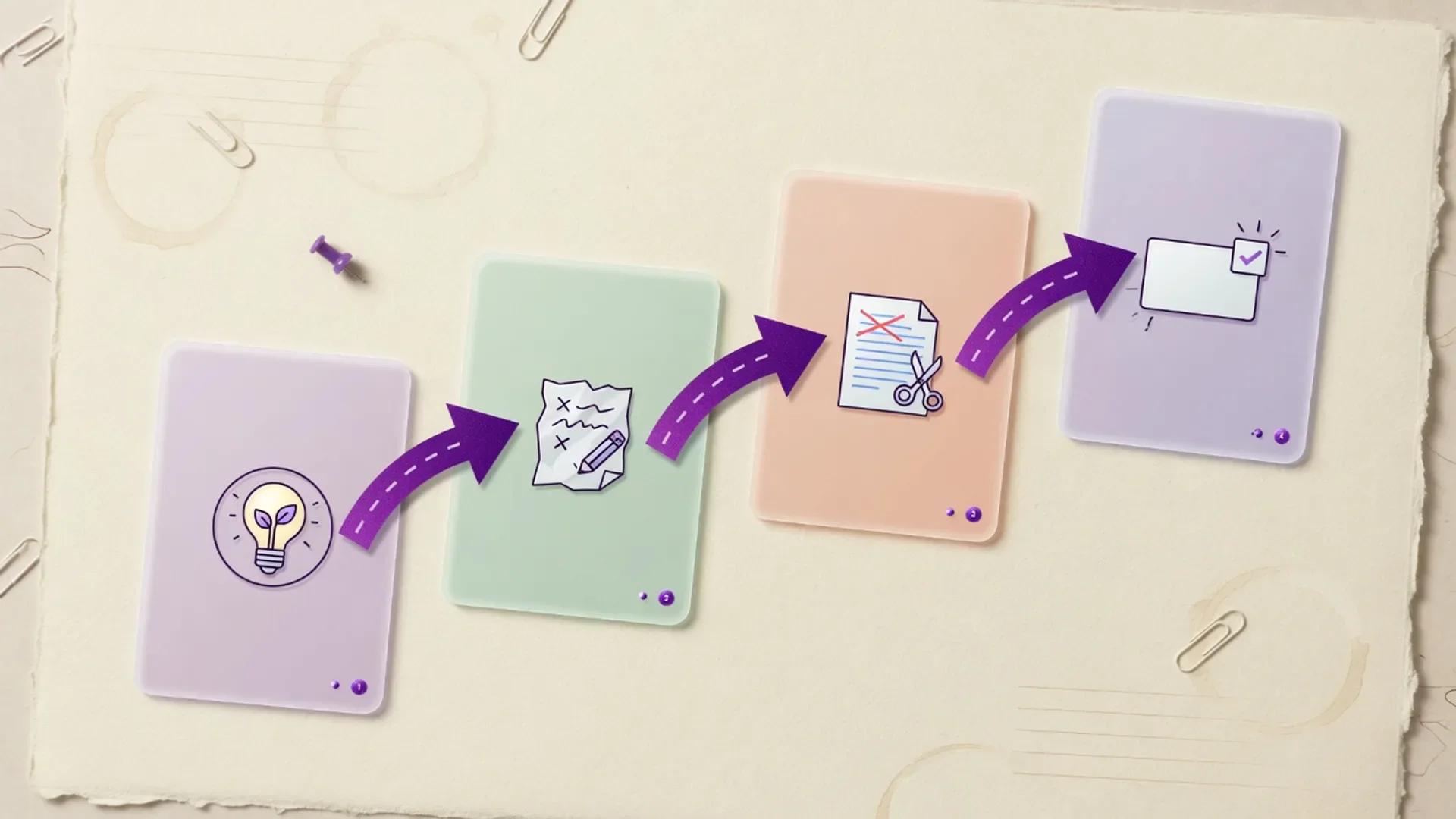
A human-led AI content marketing pipeline for turning audience evidence into cited, on-brand campaigns and measurable demand.

Customer Support AI Workflow
A practical, policy-first customer support AI workflow for triaging tickets, drafting replies, grounding agents in your knowledge base, and closing the loop with CRM context and automation, while keeping humans responsible for high-risk resolutions.

Best ChatGPT Alternatives in 2026
The best ChatGPT alternatives in 2026 are Claude for general work, Perplexity for cited research, Notion AI for workspace knowledge, GitHub Copilot for GitHub-first coding, and Cursor for agent-led software development.
Best Descript Alternatives
Looking for Descript alternatives in 2026? We compare Riverside, Opus Clip, Veed, ElevenLabs, and Otter for podcasters, YouTubers, and teams who want transcript-first editing, AI voice cloning, or short-form clipping without Descript's price tag.
Next step
Compare options side by side
Open head-to-heads, or review the primary product profile.