
Workflow playbook
Content marketers8 steps8 toolsAI Content Marketing Pipeline
A human-led AI content marketing pipeline for turning audience evidence into cited, on-brand campaigns and measurable demand.
Best for · Content marketers, founders, and small growth teams producing blogs, landing pages, and campaign assets with limited headcount.
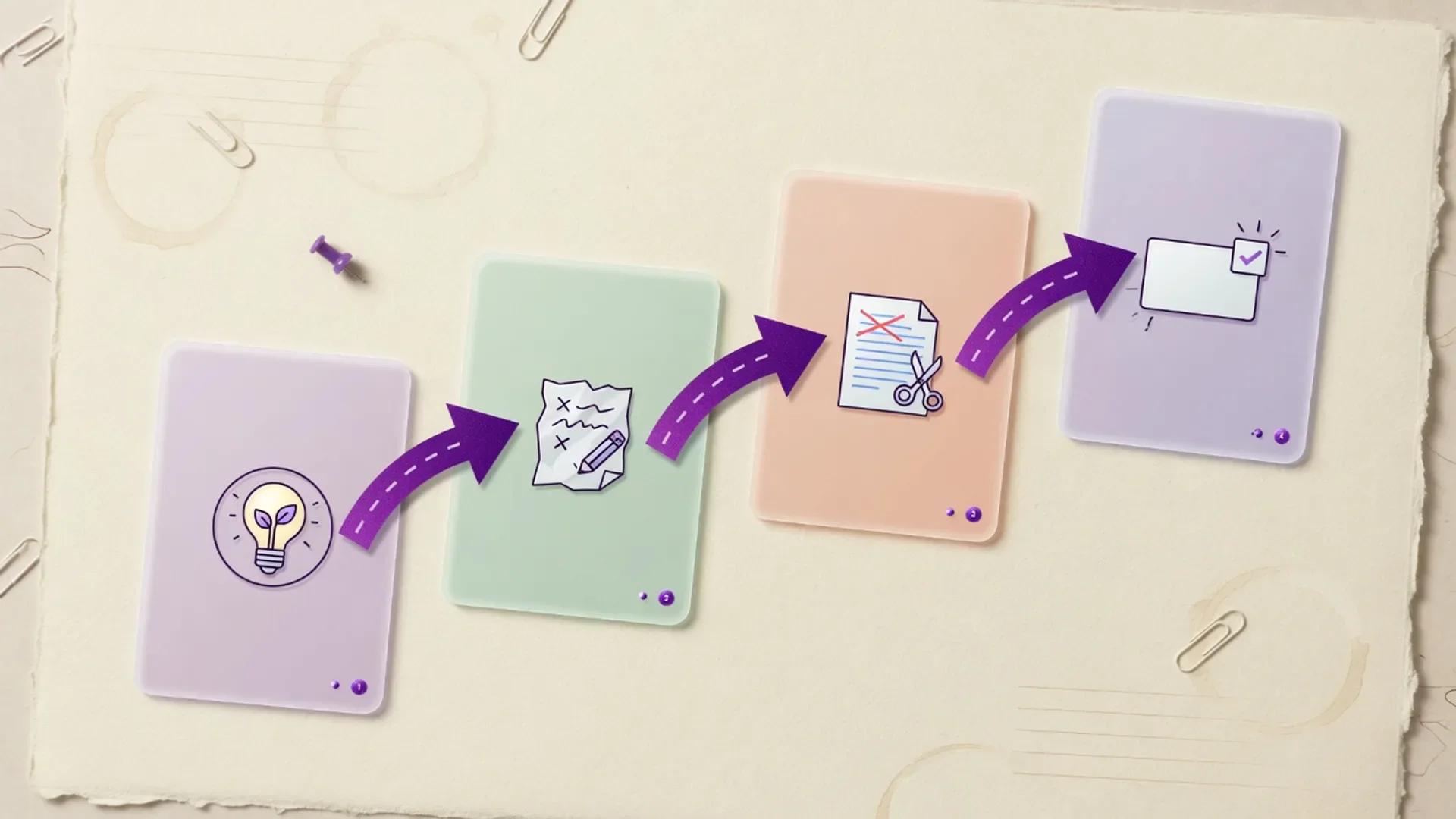
Playbook
Steps
Step 1
Define the brief and success metric
Write a one-page brief covering audience, offer, problem, funnel stage, search or campaign intent, approved proof points, exclusions, and one primary outcome. A clear intended audience and people-first purpose are stronger foundations than a target word count; Google explicitly says it has no preferred word count and warns against search-first scaled content (accessed 2026-08-02).
Step 2
Research the landscape with citations
Collect customer language, competitor angles, objections, and primary evidence. Use Perplexity or ChatGPT Search to discover sources, but open every source yourself, record its date and scope, and mark each claim as verified, contextual, opinion, or unresolved.
Step 4
Create channel variants
Repurpose only the approved master narrative into landing-page sections, email, ads, and social copy. Preserve the same audience, promise, evidence, CTA, and disclosure while changing length and format; Jasper documents brand-voice controls and governed content workflows as current capabilities (accessed 2026-08-02).
Step 5
Generate visual concepts
Use Midjourney for concepts, not unattended publishing. A human selects the direction, checks likenesses and trademarks, records the prompt and source assets, and confirms the tool's current commercial terms before the design enters production.
Step 6
Produce supporting video or audio
Turn the approved narrative into a demo, explanation, or podcast segment. Descript's terms place responsibility for checking generated output and rights on the user, while Runway's May 2026 terms likewise require users to control their inputs and content rights; treat voice, likeness, and synthetic scenes as approval items.
Step 7
Automate handoffs and publishing ops
Automate status changes, file movement, notifications, CRM notes, and reporting—not the final claim approval. Zapier describes action-level controls and checks, Make documents error-handling resources, and HubSpot positions AI agents and AEO reporting around CRM context; keep permissions narrow and log who approved publication.
Step 8
Measure, learn, and iterate
Compare the original outcome with assisted-content performance: qualified sessions, engaged visits, email replies, assisted conversions, pipeline, and revenue where attribution is defensible. Google says AI Overviews and AI Mode traffic is included in Search Console's Web reporting; use that data alongside analytics and CRM outcomes rather than treating AI visibility as a conversion.


Notes
Details
What an AI content marketing pipeline should do
An AI content marketing pipeline is a repeatable path from audience evidence to approved content, distribution, and learning. I use AI to reduce search, drafting, adaptation, and handoff friction; I keep humans accountable for truth, taste, rights, and customer impact.
Google’s current guidance says helpful content should serve an existing audience, add original value, and make its authorship and production method understandable. Its AI-features documentation says the same foundational SEO applies to AI Overviews and AI Mode: there is no secret AI markup or separate optimization requirement (Google Search Central: people-first content, accessed 2026-08-02; AI features and your website, accessed 2026-08-02).
A useful rule: automate the movement of work; never automate the ownership of a claim.
The pipeline at a glance
The workflow has eight gates. Each gate produces an artifact the next person—or the next tool—can inspect.
| Gate | Output | Human decision | Useful tools |
|---|---|---|---|
| Brief | Audience-and-offer brief | Is this worth making? | Notion AI, ChatGPT |
| Research | Source map and claim ledger | Is the evidence fit for use? | Perplexity, Claude |
| Narrative | Approved master draft | Is it true and useful? | Claude, Jasper |
| Variants | Channel package | Does each version preserve intent? | Jasper, Copy.ai, ChatGPT |
| Visuals | Rights-checked creative direction | Can we publish it commercially? | Midjourney |
| Media | Edited video or audio | Are likeness, voice, and claims cleared? | Descript, Runway |
| Operations | Logged handoffs | Who can approve and publish? | Zapier AI, Make, HubSpot AI |
| Learning | Measurement memo | What should change next time? | HubSpot AI, Notion AI |
1. Start with audience, intent, and a hard brief
A brief answers who the content is for, what job they are trying to do, why your offer helps, and what action you want next. Intent means the audience’s immediate purpose—learning, comparing, evaluating, buying, or retaining—not merely the keyword they typed.
I fill these fields before opening a generation tool:
- Audience and excluded audience
- Problem, trigger, and desired outcome
- Funnel stage and intent
- Offer, CTA, and one primary success metric
- First-party proof and allowed product claims
- Claims that require legal, subject-matter, or customer approval
- Channels, format limits, and publication deadline
- AI use, data-handling, and disclosure constraints
Example brief prompt:
Act as a research planner, not a copywriter. From the supplied customer notes, extract:
1) recurring jobs and anxieties,
2) intent stage,
3) exact customer language,
4) unanswered questions,
5) claims that need evidence.
Return a table. Do not add facts or recommendations.
2. Research questions before researching keywords
Audience research is the collection of real language and context from customers, support tickets, sales calls, forums, search results, and internal analytics. I separate discovery from proof: a search assistant can surface a lead, but the linked primary source is what earns a place in the claim ledger.
Perplexity describes itself as a search-and-answer product, and OpenAI’s current ChatGPT Search help explains that responses can include clickable source citations and that OAI-Searchbot access matters for inclusion (Perplexity Help Center, accessed 2026-08-02; OpenAI ChatGPT Search, accessed 2026-08-02).
Use this research sequence:
- List ten questions a real buyer asks before trusting the offer.
- Cluster them by job, objection, urgency, and intent.
- Search each cluster with customer wording, competitor wording, and a neutral wording.
- Prefer regulator, standards, platform, vendor, academic, and first-party evidence.
- Save URL, publisher, publication/update date, relevant passage, and limits.
- Remove claims that cannot survive source comparison.
3. Draft from a claim ledger, not a blank page
A claim ledger is a compact audit trail connecting each factual sentence to evidence and an owner. It prevents fluent prose from disguising an unsupported assertion.
| Claim | Source | Date | Scope or caveat | Reviewer | Status |
|---|---|---|---|---|---|
| Exact statement | Canonical URL | YYYY-MM-DD | Where it applies | Name | Verified |
| Product capability | Official documentation | Accessed date | Plan or beta limits | Owner | Confirm |
| Recommendation | No citation required | — | Editorial judgment | Editor | Opinion |
I ask Claude to outline from the ledger, then ask it to challenge the outline. I use Jasper when brand controls and reusable marketing context matter; its current Brand Voice page describes voice, tone, style, visual guidelines, and off-brand recommendations (Jasper Brand Voice, accessed 2026-08-02). Those controls reduce drift, but they do not verify facts.
4. Repurpose with invariants
A channel variant is a translation of an approved idea into a new format, not a new opportunity to invent proof. Keep five invariants unchanged: audience, problem, promise, evidence, and CTA.
Before approval, I check:
- The first line answers the channel’s intent.
- Product names, prices, dates, and performance claims match the ledger.
- The CTA asks for the same next step as the brief.
- Tone changes do not change certainty.
- Paid, sponsored, affiliate, synthetic, or testimonial disclosures remain visible.
5. Protect brand, rights, and disclosure
Brand governance is the set of rules, approved facts, examples, permissions, and review gates that keep content recognizably and legally usable. Copyright and commercial-use decisions still belong to the publisher; AI output is not a shortcut around licenses or consent.
The U.S. Copyright Office explains that AI copyrightability and training questions remain policy issues with separate report parts, while WIPO highlights attribution, consent, compensation, and rights-management infrastructure as live concerns (U.S. Copyright Office: Copyright and AI, accessed 2026-08-02; WIPO: AI and IP, accessed 2026-08-02).
I keep a rights packet with:
- Input ownership or license
- Model and tool terms checked date
- Consent for people, voices, and likenesses
- Asset provenance and prompt record
- Required credit or attribution
- Commercial, editorial, territory, and duration limits
- Disclosure copy and approving person
Canva’s current content license distinguishes Free, Pro, branded, and AI-generated content and restricts several standalone and AI-training uses; read the source label for every asset rather than assuming a subscription grants every right (Canva Content License Agreement, accessed 2026-08-02). For governance at larger organizations, ISO/IEC 42001 describes an AI management system for establishing, maintaining, and improving responsible AI controls (ISO/IEC 42001, accessed 2026-08-02).
6. Make generative search a quality problem
AEO means answer engine optimization: making a brand useful and discoverable when people ask an answer engine a question. GEO is often used for generative engine optimization, but I treat both as an outcome of clear, original, crawlable, well-supported content—not a promise of citation placement.
Google says AI features can use query fan-out and that indexed pages eligible for normal snippets may be supporting links; it also says Search Console reports these visits in the Web search type (Google AI features and your website, accessed 2026-08-02). I therefore publish direct answers, distinct evidence, descriptive headings, internal links, visible authorship, and structured data that matches visible content; Google recommends JSON-LD as an easy format and says inaccurate or incomplete markup is worse than less markup (Google structured data, accessed 2026-08-02).
Do not build a separate “AI page” with invented machine-readable claims. Build a page a person would bookmark, then measure branded questions, citations, qualified visits, and conversions with the caveat that answer-engine visibility is not revenue by itself.
7. Automate handoffs, not accountability
Automation is the controlled movement of approved work between systems. The safe boundary is simple: let a workflow create a review task, attach the source map, notify the owner, and draft a CRM note; require a person to approve customer-facing claims and publication.
Zapier currently describes credential management, action-level controls, checks, retries, and auditability across AI surfaces (Zapier AI, accessed 2026-08-02). Make’s official help center documents getting started and error-handling paths, while HubSpot’s 2026 Agent Hub page describes CRM-grounded agents and AEO visibility tracking (Make Help Center, accessed 2026-08-02; HubSpot Agent Hub, accessed 2026-08-02).
A practical approval automation looks like this:
- Brief status changes to
research. - Researcher attaches the claim ledger.
- Automation checks required fields and creates an editor task.
- Editor approves, requests changes, or rejects.
- Only
approvedcan trigger channel packaging. - Publication writes URL, timestamp, owner, and source snapshot to the record.
- Measurement returns to the brief library.
8. Measure outcomes and update the system
Measurement is the comparison between the brief’s intended outcome and observed behavior. I track production efficiency separately from audience value so faster drafting cannot hide weaker demand.
| Layer | Questions | Examples |
|---|---|---|
| Quality | Is it true and on brand? | Reviewer defects, corrections, rights exceptions |
| Reach | Did the intended audience find it? | Qualified impressions, search clicks, AI referrals |
| Engagement | Did it help? | Engaged sessions, scroll depth, replies, saves |
| Action | Did behavior advance? | Signup, demo, trial, assisted conversion |
| Business | Did it matter? | Qualified pipeline, revenue, retention signal |
| Operations | Can we repeat it safely? | Cycle time, handoff failures, approval latency |
Run a monthly learning review: keep winning questions, rewrite unclear answers, retire claims with expired evidence, and revise prompts only after identifying the failure they should fix. NIST’s AI RMF is voluntary guidance for managing AI risks and trustworthiness, and its page notes a generative-AI profile and 2026 revision work; I use that risk mindset for content controls without presenting it as a legal certification (NIST AI RMF, accessed 2026-08-02).
FAQ
How much of content marketing should AI automate?
Automate repetitive transformation and routing first. Keep strategy, evidence judgment, rights, sensitive claims, and final publication human-owned.
Is GEO a replacement for SEO?
No. Google’s current documentation says the foundational SEO requirements remain relevant for AI features and says no special AI optimization is required. GEO is a useful measurement and planning label, not a guaranteed ranking lever.
Should I disclose AI assistance?
Disclose when readers could reasonably wonder how the work was made, especially for synthetic voices, likenesses, testimonials, or substantially generated material. Match the disclosure to the risk and your jurisdiction, platform, contract, and industry rules.
How do I verify an AI-generated statistic?
Open the original source, confirm the date, definition, population, and denominator, then find an independent source that measures the same thing. If the two do not align, remove the number or state the limitation.
Which tool should I start with?
Start with the tool already holding your approved context and workflow state. A small team can begin with Notion AI, ChatGPT, Perplexity, Claude, and one automation layer, then add specialist creative or CRM tools when a measured bottleneck justifies them.
Stack
Tools used in this workflow

Notion AI
Editorially ResearchedAI writing, knowledge agents, and meeting notes built into the Notion workspace teams already use.
Stands out · Notion AI is the only AI built directly into the workspace where teams already store docs, wikis, projects, and meeting notes — so it works on your real context, not in a separate chat window.


Perplexity
Editorially ResearchedAI-powered answer engine that pairs search with cited synthesis for faster research.
Stands out · An answer engine built around citations, then extended to an AI browser and a multi-model Computer that runs work for you.


Claude
Editorially ResearchedAnthropic's AI assistant focused on careful writing, long-context work, and the strongest agentic coding stack as of July 2026.
Stands out · A general-purpose assistant and agent platform optimized for careful writing, 1M-token long-context work, and the strongest agentic coding surface in 2026 — anchored by Opus 5, Sonnet 5, Fable 5, Claude Code, and Claude Cowork.


Jasper
Editorially ResearchedAI content platform built for marketing teams that need brand-consistent campaigns at scale.
Stands out · A marketing-first AI content platform with brand voice and campaign workflows aimed at team production, not just one-off chat drafts.

Copy.ai
Editorially ResearchedAI-native go-to-market platform built by Fullcast, automating marketing, sales, and RevOps workflows end-to-end.
Stands out · LLM-agnostic, no-code Workflows that codify end-to-end GTM processes across sales, marketing, and ops, now backed by Fullcast.


ChatGPT
Editorially ResearchedOpenAI's general-purpose AI assistant for writing, analysis, coding help, and everyday knowledge work.
Stands out · A mainstream, general-purpose AI assistant with the broadest multimodal feature surface and one of the largest everyday user bases for conversational AI.


Midjourney
Editorially ResearchedHigh-quality AI image generation for concept art, brand exploration, and creative production.
Stands out · A generation-first creative tool prized for aesthetic image quality and iterative visual exploration.


Descript
Editorially ResearchedAI video and podcast editor that cuts by editing the transcript, with 2026-era Underlord agent, Studio Sound, and 4K remote Rooms.
Stands out · A creator-first editor where the transcript is the primary interface, now expanded into an agentic AI workspace with Underlord, 4K remote Rooms, and regenerative video inpainting.

Runway
Editorially ResearchedAI creative suite for generative video, image, audio, and now world-model infrastructure for marketing, film, and enterprise production.
Stands out · An AI creative platform that pairs frontier video models (Gen-4.5, Aleph 2.0) with a true production workspace, the Runway Agent, and a developer platform with a Model Router.

Zapier AI
Editorially ResearchedThe no-code automation platform that quietly became the AI governance layer for the rest of your SaaS stack.
Best for · Teams that need broad app connectivity, AI-assisted workflow building, and a single governance layer for every AI surface they adopt.


Make
Editorially ResearchedVisual AI automation platform for building complex multi-app scenarios and AI agents on a transparent canvas.
Stands out · A visual AI automation canvas where next-gen Make AI Agents, MCP, and Make Grid observability ship together on every paid plan — purpose-built for complex, multi-app workflows.


HubSpot AI
Editorially ResearchedHubSpot's Breeze AI and Agent Hub bring context-aware generative and agentic AI into the CRM, sales, marketing, and service hubs where your customer data a…
Stands out · AI assistance and autonomous agents embedded across the HubSpot customer platform, with credit-based pricing that only bills when the agent actually delivers work.
Related
Related reading
HubSpot AI vs ChatGPT
Pick HubSpot AI when the work is contacts, deals, tickets, and campaigns inside HubSpot. Pick ChatGPT when the work is open-ended drafting, research, multi-tool reasoning, or anything not tied to a CRM object.

Notion AI vs Claude
Choose Notion AI when your team's knowledge, projects, and meetings already live in Notion and you want an agent that can take action inside that workspace. Choose Claude when you want the best standalone writing, reasoning, and long-document analysis regardless of which wiki you use.
Zapier AI vs n8n
Pick Zapier AI when business users need the fastest path to a working automation across 9,000+ mainstream SaaS apps. Pick n8n when engineers want code, self-host, and execution-based pricing for complex or high-volume AI workflows.

Runway vs Synthesia
Choose Runway for generative creative video, VFX, and cinematic production. Choose Synthesia for scalable avatar training, sales enablement, and multilingual business video.

marketing tools
Browse the marketing category

content tools
Browse the content category
Keep building
Explore more playbooks and tools
Browse more workflows, or shortlists built around the same stack.